
If you've read anything about collagen supplementation, you've probably come across the advice to pair it with vitamin C. It gets mentioned frequently — in wellness articles, on supplement labels, in fitness communities — but rarely with much explanation beyond "vitamin C helps collagen work better."
That vague advice undersells a genuinely important relationship. Vitamin C and collagen don't just complement each other in a general wellness sense — they are biochemically dependent on each other in ways that directly affect whether your daily collagen habit actually delivers results. Understanding why changes how you approach both.
First: Why Your Body Can't Make Collagen Without Vitamin C
Collagen synthesis is not a simple process. When your body produces collagen, it goes through a series of tightly regulated biochemical steps — and vitamin C is an essential cofactor at one of the most critical points in that chain.
Specifically, vitamin C is required to activate two enzymes: prolyl hydroxylase and lysyl hydroxylase. These enzymes are responsible for hydroxylating (chemically modifying) the amino acids proline and lysine in the collagen structure. Without this step, the collagen triple-helix — the stable, tightly wound structure that gives collagen its strength and function — cannot form correctly.
In practical terms: without adequate vitamin C, your body cannot produce structurally sound collagen, regardless of how many collagen peptides you're consuming. The amino acids are there, but the machinery needed to assemble them properly is missing a critical component.
This is not a fringe theory. It's foundational biochemistry, demonstrated clearly by the consequences of severe vitamin C deficiency — scurvy — which is characterized by collagen breakdown, skin deterioration, joint pain, and poor wound healing. The body's collagen architecture literally begins to fall apart when vitamin C is absent.
What This Means for Collagen Supplementation
When you take hydrolyzed collagen peptides, your body breaks them down into amino acids — primarily glycine, proline, and hydroxyproline — which enter the bloodstream and signal fibroblast cells to ramp up collagen production. This is the core mechanism behind why collagen supplementation works.
But that fibroblast signaling and subsequent collagen synthesis still requires the full enzymatic process described above. Which means vitamin C needs to be present and available for those amino acids to be properly assembled into new collagen fibers.
Research confirms this directly. Studies have shown that vitamin C stimulates collagen synthesis in human fibroblasts in a dose-dependent manner — the more available vitamin C is, the more collagen those cells produce. Separate research has demonstrated that when vitamin C levels in the skin increase, measurable improvements in skin thickness and collagen density follow. The relationship is not indirect or theoretical — it is a direct, causal one.
This is why pairing collagen supplementation with adequate vitamin C intake isn't just a nice-to-have. It's genuinely important for getting the most out of your daily collagen habit.
Vitamin C as an Antioxidant: The Second Layer of the Story
Beyond its role in collagen synthesis, vitamin C contributes to collagen health through a second, equally important mechanism: antioxidant protection.
Collagen fibers — both existing ones in your skin and joints and newly synthesized ones — are vulnerable to damage from free radicals and oxidative stress. Free radicals are unstable molecules produced by normal metabolic processes, UV exposure, pollution, and other environmental factors. When they attack collagen fibers, they accelerate degradation and contribute to the visible signs of aging — wrinkles, loss of elasticity, and uneven skin texture.
Vitamin C is one of the body's most powerful water-soluble antioxidants. It neutralizes free radicals before they can damage collagen structures, effectively protecting the investment your body is making in collagen synthesis. This antioxidant function is particularly relevant for skin health — vitamin C helps defend against the collagen-damaging effects of UV exposure and environmental stressors that accelerate the aging process from the outside.
In this sense, vitamin C is doing double duty: helping build new collagen on one side, and protecting existing collagen from breakdown on the other. Both functions matter, and together they make a meaningful difference in long-term skin health and collagen density.
How Much Vitamin C Do You Actually Need?
Here's where the practical question becomes important. Most healthy adults who eat a reasonably varied diet are not severely deficient in vitamin C. But there's a difference between avoiding deficiency and maintaining the optimal levels needed for active collagen synthesis.
The body doesn't store vitamin C long-term — it's water-soluble, which means it's excreted relatively quickly and needs to be replenished regularly through diet or supplementation. Research suggests that maintaining optimal plasma vitamin C levels — in the range of around 200–250mg per day — is associated with meaningful skin benefits, including increased collagen production and epidermal thickness.
The good news is that reaching this level through diet is entirely achievable. Foods particularly rich in vitamin C include:
- Citrus fruits (oranges, grapefruit, lemons)
- Bell peppers — particularly red and yellow, which contain significantly more vitamin C than oranges
- Kiwi fruit — one of the most concentrated dietary sources
- Strawberries and other berries
- Broccoli and other cruciferous vegetables
- Tomatoes
A handful of strawberries in a smoothie, a glass of orange juice, or a portion of broccoli at dinner can easily cover your daily vitamin C needs. If dietary intake is inconsistent, a basic vitamin C supplement is a simple, inexpensive way to ensure adequate levels daily.
The Optimal Way to Pair Collagen and Vitamin C
Given the biochemical relationship between the two, the most effective approach is to consume vitamin C around the same time as your collagen supplement — or as part of the same meal or drink.
The most practical pairings:
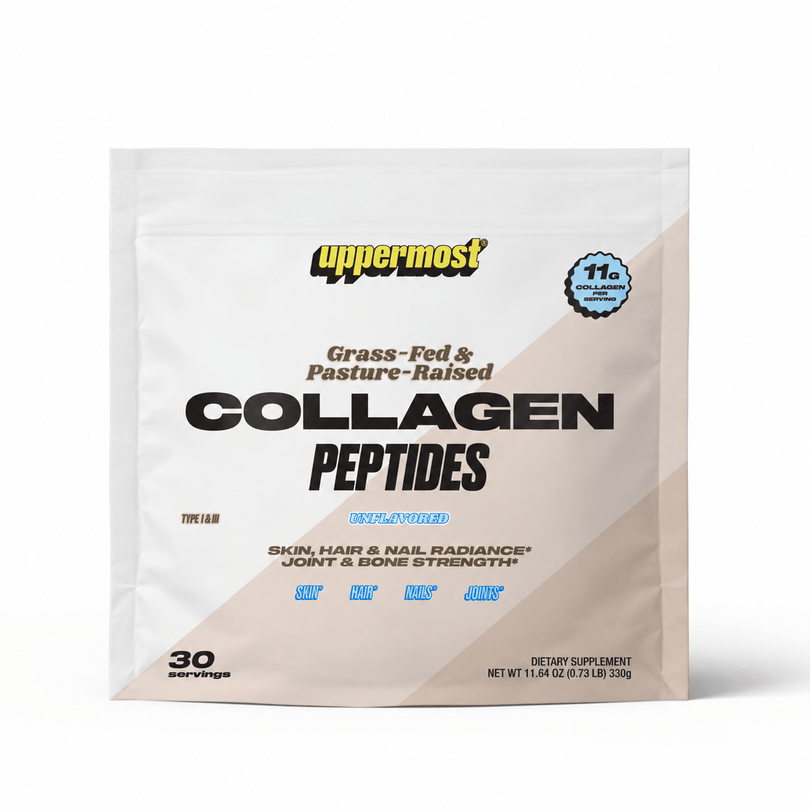
Collagen in a berry smoothie. Adding a scoop of Uppermost Collagen Peptides to a smoothie with berries, kiwi, or citrus naturally combines both in one drink. Completely unflavored, the collagen disappears into the blend without changing anything about how it tastes.
Collagen in coffee or tea, with orange juice on the side. Your morning collagen habit and a glass of orange juice at breakfast is a simple, effortless combination that covers both bases without any extra effort.
Collagen stirred into warm lemon water. A popular morning ritual that neatly combines both — lemon provides a meaningful dose of vitamin C, and collagen dissolves cleanly into warm water with no taste or texture change.
Collagen added to a smoothie alongside vitamin C-rich fruits. The classic smoothie base of banana, berries, and spinach delivers both nutrients in a single, convenient drink.
The key point is that you don't need to take them simultaneously in some precise window — the goal is simply to ensure that your body has adequate vitamin C available on a daily basis, and that it's present when collagen synthesis is most active. A consistent daily habit of both is all that's required.
Does Topical Vitamin C Work for Collagen Too?
This is a common question, and the honest answer is: less effectively than internal vitamin C for collagen synthesis purposes.
Vitamin C is water-soluble, which makes it poorly suited to penetrating the outer skin barrier through topical application. While vitamin C serums and creams are widely used and do offer some surface-level antioxidant benefits, research consistently shows that vitamin C delivered internally through the bloodstream reaches skin cells far more efficiently than topically applied vitamin C, which struggles to penetrate beyond the outer skin layer.
This has a practical implication: while a good vitamin C serum has its place in a skincare routine, it's not a substitute for dietary or supplemental vitamin C when it comes to supporting the deeper collagen synthesis that creates lasting structural changes in skin. The inside-out approach — oral collagen paired with adequate dietary vitamin C — addresses the root of the process rather than the surface.
A Simple Daily Stack That Works
If you're taking collagen daily and want to maximize what it does for your skin, hair, nails, and joints, the most evidence-supported habit is straightforward:
One scoop of Uppermost Grass-Fed Collagen Peptides, taken daily, alongside a vitamin C-rich food or drink. That's it. No complicated supplement stacking, no precise timing windows, no expensive add-ons. Just two things your body genuinely needs, taken consistently every day.
The collagen provides the amino acid building blocks. The vitamin C activates the enzymes that assemble them into functional collagen fibers. Together, they support a process your body is already running — they just give it the best possible inputs to work with.
Ready to build your daily stack? Uppermost Grass-Fed Collagen Peptides — 11g per scoop, hydrolyzed Type I & III, sourced from grass-fed pasture-raised bovine in Argentina. Nothing artificial, ever.