
If you've spent any time researching collagen supplements, you've almost certainly run into this debate. Marine collagen and bovine collagen dominate the market, and the conversation around which is "better" can get confusing quickly — especially when both sides have legitimate points and seemingly compelling research to back them up.
The honest answer is that neither is universally superior. They have different strengths, different collagen type profiles, and different ideal use cases. Understanding those differences clearly is what allows you to make the right choice for your specific goals — rather than simply buying whatever a brand is most aggressively marketing.
Here's the full picture.
What Is Marine Collagen?
Marine collagen is derived from the skin and scales of fish. It is almost exclusively composed of Type I collagen — the most abundant collagen type in the human body, and the primary structural protein in skin, hair, nails, and bones.
One notable characteristic of marine collagen is its peptide size. Marine collagen peptides tend to be smaller in molecular weight than bovine collagen peptides, which is often cited as an advantage for absorption. Smaller peptides pass through the gut wall more efficiently, meaning they may enter the bloodstream faster.
Marine collagen is also a meaningful option for people who follow a pescatarian diet or avoid beef products for dietary, religious, or personal reasons.
What Is Bovine Collagen?
Bovine collagen is derived from the hides of cattle. Unlike marine collagen, it contains both Type I and Type III collagen — making it a broader-spectrum collagen source.
Type I collagen is the same as found in marine collagen: the key structural protein for skin, hair, nails, and bones. Type III collagen works alongside Type I, particularly in skin, blood vessel walls, and organ tissue. It's also meaningfully involved in gut lining integrity and connective tissue throughout the body.
This dual collagen type profile is what makes bovine collagen such a versatile supplement — it supports a wider range of biological structures simultaneously, rather than focusing primarily on skin-oriented Type I collagen alone.
Bovine collagen is also the most extensively studied form of collagen supplementation. The majority of the clinical research supporting collagen's benefits for skin, joints, hair, and gut health has been conducted using hydrolyzed bovine collagen peptides — which means the evidence base is deeper and more established.
The Bioavailability Question
One of the most frequently cited arguments in favor of marine collagen is bioavailability. Because marine collagen peptides are smaller, they are often described as being absorbed more efficiently than bovine collagen peptides.
This is partially true — and partially overstated.
Marine collagen peptides do tend to have a slightly smaller average molecular size, which can support faster initial absorption. However, high-quality hydrolyzed bovine collagen peptides are also highly bioavailable. The hydrolysis process specifically exists to break collagen down into smaller chains that absorb efficiently — and quality bovine collagen products are processed to optimize exactly that.
The practical difference in absorption between a high-quality hydrolyzed bovine collagen and a comparable marine collagen is meaningful in a laboratory context, but less so in real-world daily supplementation. Both forms, taken consistently, deliver collagen amino acids to your bloodstream and support the same underlying biological processes.
The more important variable for most people is not which source absorbs marginally faster — it's whether the product is genuinely hydrolyzed, clean, and of high sourcing quality. A well-sourced, properly hydrolyzed bovine collagen will outperform a poorly processed marine collagen in practice, regardless of the molecular size advantage.
Collagen Type: Why It Matters More Than the Source
The most substantive difference between marine and bovine collagen is not absorption rate — it's collagen type composition. And this is where your specific goals should guide your decision.
If your primary goal is skin health and anti-aging: Both marine and bovine collagen support skin health through Type I collagen. Marine collagen's exclusive Type I focus makes it a clean, targeted option for skin-specific benefits. Bovine collagen also delivers Type I collagen, alongside Type III, which additionally supports skin elasticity and structure. For skin goals alone, both are effective — the Type I collagen is present in both.
If your goals extend beyond skin: Bovine collagen's Type III content makes it meaningfully more relevant for joint support, gut health, muscle recovery, and broad connective tissue health. Type III collagen is involved in the structural integrity of organs, blood vessels, and the gut lining in ways that Type I alone does not cover. If you're supplementing for whole-body support — skin, joints, gut, hair, and nails together — bovine collagen's broader type profile is the more logical choice.
For hair health specifically: Both types support hair through the amino acids they provide for keratin synthesis. Marine collagen's high hydroxyproline content is particularly noted for hair-related benefits. Bovine collagen, however, supports hair follicle health through a different mechanism — reinforcing the structural niche that surrounds the follicle. Both are genuinely relevant; the difference is in mechanism rather than outcome for most people.
Amino Acid Profile: Similarities and Differences
Both marine and bovine collagen are rich in the key amino acids that drive collagen's benefits: glycine, proline, and hydroxyproline. These are the building blocks that fibroblast cells use to synthesize new collagen throughout the body.
The differences are in the relative concentrations:
- Bovine collagen tends to be higher in glycine and hydroxyproline — amino acids particularly important for skin structure, muscle repair, and connective tissue support. Glycine also plays a meaningful role in gut health, supporting the integrity of the intestinal lining.
- Marine collagen is notably rich in hydroxyproline specifically, an essential component of skin, blood vessel walls, and other connective tissues, and is often associated with particularly strong skin hydration and elasticity outcomes.
Both profiles are beneficial. The differences are meaningful for understanding the nuance of each source but should not be overstated — both deliver the core amino acids that make collagen supplementation effective.
Sustainability and Allergen Considerations
Allergens: This is a practical consideration that can settle the decision for some people immediately. Bovine collagen is not suitable for anyone with a beef or bovine allergy. Marine collagen is not suitable for anyone with a fish or shellfish allergy. If either applies to you, the choice is straightforward.
Sustainability: Both sources can be sustainably produced when handled responsibly. Marine collagen is often produced from fish skin and scales — byproducts of the seafood industry that would otherwise be discarded, giving it a relatively low additional environmental footprint. Bovine collagen similarly uses hides from cattle raised primarily for beef, meaning it represents a use of material that would otherwise go to waste.
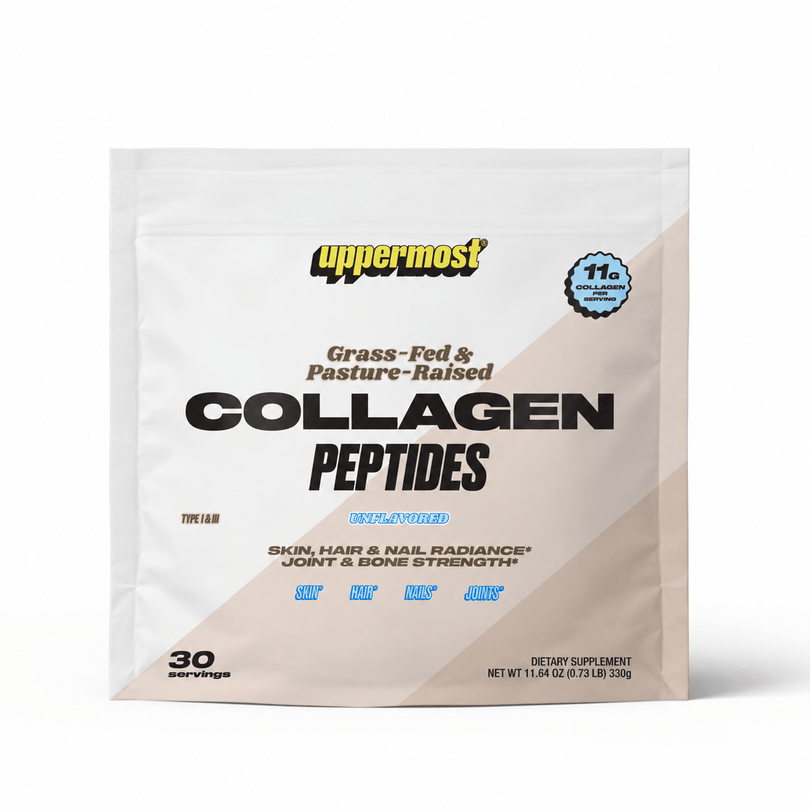
For bovine collagen specifically, sourcing from grass-fed, pasture-raised cattle significantly improves the sustainability and ethical profile of the product. Cattle that graze freely on open pastures have a fundamentally different environmental footprint than those raised in confined feedlot conditions. Uppermost sources exclusively from grass-fed, pasture-raised cattle in Argentina — a sourcing standard that matters both for product quality and for the broader environmental picture.
Taste and mixability: Bovine collagen is generally considered to have a more neutral flavor profile than marine collagen, which can carry a faint fishy aftertaste depending on processing quality. Both dissolve well in liquid when properly hydrolyzed. Uppermost Collagen is completely unflavored and odorless, dissolving cleanly into coffee, smoothies, water, or any other drink without changing the taste in any way.
Cost
Bovine collagen is generally more affordable and more widely available than marine collagen, which tends to command a premium. For a supplement you're taking every single day over months and years, this is a practical consideration worth factoring in. A higher-cost supplement that you take inconsistently because of the expense is less effective than a quality, fairly-priced product you take without hesitation every morning.
So Which Should You Choose?
Here's a simple framework:
Choose marine collagen if:
- You follow a pescatarian diet or avoid beef products
- Your goals are specifically and exclusively skin-focused
- You have a bovine or beef allergy
Choose bovine collagen if:
- You want whole-body support — skin, hair, nails, joints, gut, and connective tissue
- You want the most extensively researched form of collagen supplementation
- You prefer a completely neutral taste and easier mixability
- You want the added benefit of Type III collagen alongside Type I
- Sustainable, traceable sourcing from grass-fed cattle matters to you
For most people — particularly those supplementing for anti-aging, skin health, hair and nail strength, and joint support simultaneously — bovine collagen's broader Type I and III profile makes it the more complete daily supplement. It covers more ground without requiring you to manage multiple products, and the clinical research behind it is robust and well-established.
The Bottom Line
Marine and bovine collagen are both legitimate, effective options. The debate is less about which is objectively better and more about which is better suited to your specific goals, dietary preferences, and lifestyle. For whole-body collagen support with a clean, neutral-tasting powder backed by extensive research, grass-fed bovine collagen peptides cover the full spectrum of what most people are looking for in a daily collagen habit.
One scoop. Every day. The source matters — make sure you know what's in yours.
Uppermost Grass-Fed Collagen Peptides — Type I & III, hydrolyzed, sourced from grass-fed pasture-raised bovine in Argentina. Nothing artificial, ever. Shop now.