

If you've started looking into collagen supplements, you've probably noticed that dosage advice varies wildly depending on where you look. Some products suggest a modest 5g per day; others push 20g or more. Influencers swear by their personal routines, and every brand seems to have a different "optimal" serving size conveniently matching exactly what's in their product.
So what's actually right?
The honest answer: it depends on your goal. But there's a practical range that works well for most people, and it's simpler than the conflicting advice online suggests. Let's break it down.
Why Collagen Intake Matters More After Your Mid-20s
Before getting into numbers, it helps to understand why supplementing collagen makes sense in the first place.
Collagen is the most abundant protein in the human body — the structural backbone of your skin, hair, nails, joints, bones, and gut lining. It's what keeps skin firm and elastic, joints cushioned and mobile, and hair and nails strong and resilient.
The problem is that your body produces roughly 1% less collagen every year starting in your mid-20s. By the time most people notice the visible signs — fine lines, slower nail growth, stiffer joints after a workout — the decline has already been underway for years. Supplementing with hydrolyzed collagen peptides helps replenish what time quietly depletes, giving your body the amino acid building blocks it needs to keep producing collagen of its own.
This is also why dosage and consistency matter. You're not taking collagen to get an immediate effect — you're investing in a daily habit that supports your body's natural processes over time.
What the Research Actually Says
Most clinical studies on collagen peptides use daily doses between 2.5g and 15g, and the results point to a few consistent patterns depending on the goal:
- Skin hydration and elasticity: meaningful improvements observed at doses as low as 2.5g–5g per day, with stronger results at 10g
- Joint comfort and mobility: studies typically use 10g per day, taken consistently over 3–6 months
- Hair and nail strength: research generally falls in the 2.5g–10g range
- Muscle support and recovery: studies tend to use 15g or more, often timed around exercise
The key takeaway here is that you don't need massive doses to see results. The research consistently shows that regular, daily use at a moderate dose outperforms irregular use at any amount. More is not always better — consistency is what drives results.
A Practical Starting Point: 10–15g Per Day
For most healthy adults seeking skin, hair, nail, and joint benefits, 10g to 15g of collagen peptides per day is a well-supported, practical daily dose. It covers the full range studied across all the main benefit areas without going overboard.
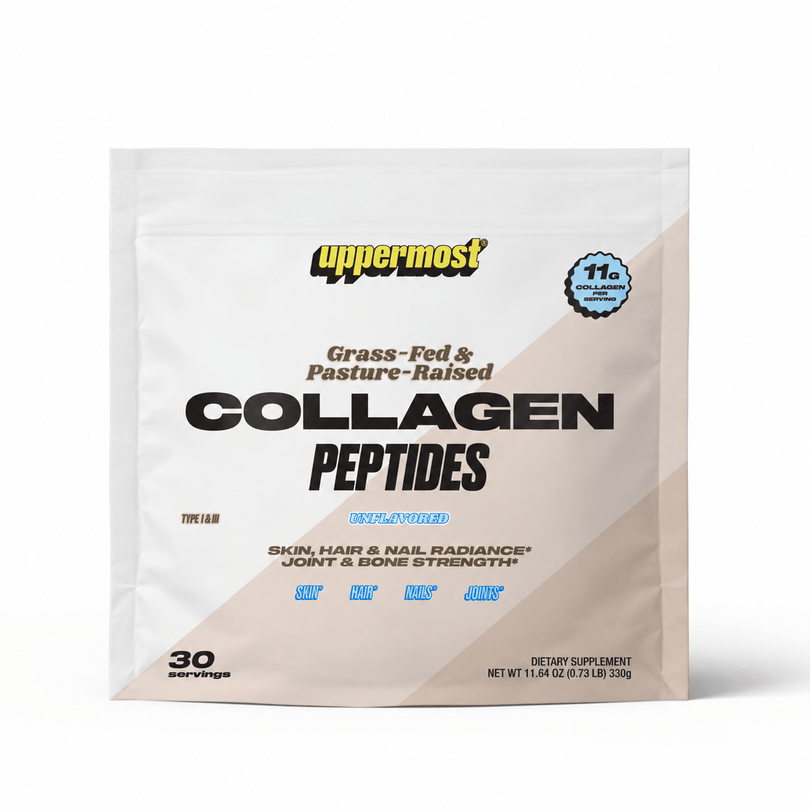
One scoop of Uppermost Collagen Peptides delivers 11g of hydrolyzed Type I & III collagen per serving — sitting right in this sweet spot. One scoop a day, consistently, is genuinely all most people need to start seeing and feeling a difference.
Does the Type of Collagen Matter for Dosage?
Yes — and it's worth understanding the difference before you buy anything.
Type I and III collagen are the most abundant types in the human body. Type I is the primary structural protein in skin, hair, nails, and bones. Type III works alongside it, particularly in skin and blood vessels. Together, they're what most people think of when they talk about collagen's beauty and anti-aging benefits — and they're the types found in bovine collagen peptide supplements like Uppermost.
Type II collagen is different. It's found primarily in cartilage and is often studied separately, at lower doses (around 10mg in some undenatured forms), specifically for joint health. It's more commonly found in chicken-derived collagen supplements.
For skin, hair, nails, and general anti-aging support, Type I and III at 10–15g per day is your target. If joint health is your primary concern, a bovine Type I and III collagen at the same dose also covers that ground well.
Why Grass-Fed Collagen May Work Better
Not all collagen peptides are equal, and sourcing genuinely affects quality — something worth paying attention to when you're committing to a daily supplement.
Collagen from grass-fed, pasture-raised cattle tends to have a cleaner amino acid profile compared to grain-fed or feedlot sources. The cattle live and eat as nature intended, grazing freely on open pastures, which influences the quality of the protein they produce. No unnecessary hormones, no antibiotics, no inferior inputs hidden behind a label.
Uppermost sources exclusively from grass-fed, pasture-raised bovine cattle in Argentina, where the climate allows cattle to graze year-round on open pastures. It's a sourcing standard that genuinely matters — because you're taking collagen every day, and the quality of what you're consistently putting into your body adds up over time.
When Should You Take Collagen?
The research doesn't point strongly to a single "best" time of day, but a few practical principles apply.
Morning tends to be the most sustainable habit. Most people find that adding collagen to their morning coffee, tea, or smoothie becomes second nature within a week or two. Uppermost Collagen is completely unflavored and odorless — it dissolves cleanly without altering the taste of whatever you're drinking. The less friction there is in your routine, the more likely you are to stay consistent.
Take it with vitamin C when possible. Vitamin C plays a direct role in collagen synthesis in the body. Pairing your daily collagen with a vitamin C-rich food or supplement — a glass of orange juice, some berries, or a dedicated supplement — may enhance how effectively your body puts those amino acids to work.
Around exercise if you're active. Some research suggests consuming collagen 30–60 minutes before exercise may support connective tissue repair and adaptation. If you work out in the morning, this conveniently aligns with an existing routine anyway.
The bottom line on timing: the best time to take collagen is whenever you'll actually do it every day. Habit and consistency will always matter more than optimizing the clock.
How Long Until You See Results?
This is the question everyone wants answered honestly. The timeline looks like this for most people:
- 4–6 weeks: Nail strength and skin hydration are usually the first improvements people notice
- 8–12 weeks: Hair thickness and joint comfort typically follow with consistent daily use
- 3–6 months: Skin elasticity and deeper structural improvements become more visible
Collagen works cumulatively and quietly. One scoop every day is significantly more effective than two scoops occasionally. Most people notice the results when they realize something has changed — their nails aren't breaking the way they used to, their skin looks a little more even, their knees feel easier after a run — rather than watching it happen day by day.
That gradual, compounding quality is exactly why making it a non-negotiable part of your daily routine from the start is the single most important thing you can do.
Who Should Be Cautious
Collagen peptides are well-tolerated by the vast majority of people with no significant side effects. That said, a few things to know:
- If you have a beef or bovine allergy, bovine collagen isn't suitable for you
- If you're pregnant or breastfeeding, check with your healthcare provider before starting any new supplement
- If you experience mild digestive adjustment in the first few days, starting with half a scoop and building up is a gentle way to ease in
- Vegans and vegetarians should note that bovine collagen is animal-derived and not plant-based
The Bottom Line
One scoop of a quality grass-fed collagen peptide powder — delivering around 10–15g of hydrolyzed Type I & III collagen — taken daily, is all most people need. Consistency matters more than quantity. Source and quality matter more than chasing the highest dose on the market.
Make it part of your morning. Give it 6–8 weeks of genuine daily use. Your skin, hair, nails, and joints will reflect the habit before you consciously register that something has changed — and that's exactly how good supplements are supposed to work.
Ready to start your collagen habit? Uppermost Grass-Fed Collagen Peptides — 11g per scoop, sourced from grass-fed pasture-raised bovine in Argentina, nothing artificial, ever.