
If you've just started taking collagen — or you're thinking about it — one of the first things you want to know is: when will I actually notice a difference?
It's a fair question, and an important one. Collagen supplements aren't cheap, and committing to a daily habit is easier when you know what to expect and when. The problem is that the answers you'll find online range from "within days" (unrealistic) to "it might never work" (overly pessimistic). The truth sits somewhere in between — and it's actually more encouraging than the skeptics suggest.
Here's what the research says, broken down into a realistic, goal-by-goal timeline.
First, Understand How Collagen Actually Works
Before diving into timelines, it helps to understand the mechanism — because it explains why collagen takes time.
When you take hydrolyzed collagen peptides, your body breaks them down into amino acids and small peptide chains that are absorbed into the bloodstream. Once there, they don't simply "become collagen." Instead, they act as biological signals — telling your body's fibroblast cells to ramp up their own natural collagen production.
This is an important distinction. Collagen peptides don't directly replace lost collagen; they stimulate your body's own production processes. That signaling takes time to translate into visible, structural change in your skin, joints, or hair. You're not applying a topical cream to the surface — you're working with your body's biology from the inside out.
This is also why consistency is so critical. You can't signal your body once and expect lasting results. The benefits are cumulative, building steadily with daily use over weeks and months.
The Realistic Timeline: What to Expect and When
Weeks 1–3: Nothing Visible Yet (And That's Normal)
In the first few weeks, don't expect to see or feel much. This isn't a sign that it isn't working — it's just how biological processes operate. Most people who quit early do so right in this window, expecting a pain reliever's speed from a structural rebuilding process.
Your body is absorbing the peptides, signaling fibroblasts, and beginning to ramp up collagen synthesis. The foundation is being laid. Stay consistent.
Weeks 4–6: The First Signs
The 4–6 week mark is typically when the first subtle but real changes begin to emerge. For most people, these tend to be:
- Skin hydration: skin may feel plumper and more moisturized
- Nail strength: nails that used to break or peel start to feel more resilient
- Reduced hair shedding: some people notice less hair coming out in the shower
These early signals are worth paying attention to — they're confirmation that the daily habit is doing its job.
Weeks 8–12: More Meaningful Changes
This is the window where most people start to notice real, visible differences. Skin elasticity improves, fine lines may appear softened, and the structural benefits begin to show more clearly.
For joint comfort and mobility, multiple studies report noticeable reductions in joint stiffness and discomfort in this range, especially in active individuals and those over 40.
By this point, most consistent users report:
- Visibly smoother skin texture and reduced fine lines
- Stronger, faster-growing nails
- Reduced joint stiffness after activity or in the morning
- Improved hair thickness and shine
Months 3–6: The Full Picture
This is the stage where results really compound. Skin density, elasticity, and overall tone continue to improve. Joint comfort becomes more consistently better rather than occasionally better. Hair thickness becomes measurably different.
For anyone supplementing primarily for longer-term concerns — bone health, gut lining integrity, deeper skin remodeling — this is the timeframe where those benefits accumulate most meaningfully. The 3–6 month mark is also where the difference between people who stayed consistent and those who didn't becomes most apparent.
Does Your Goal Affect the Timeline?
Yes — different goals have different timelines. Here's a quick reference:
| Goal | When to Expect Results |
|---|---|
| Skin hydration | 4–6 weeks |
| Nail strength | 4–8 weeks |
| Fine lines & skin elasticity | 8–12 weeks |
| Hair thickness | 8–16 weeks |
| Joint comfort & mobility | 6–12 weeks |
| Muscle recovery support | 8–12 weeks (with exercise) |
| Deeper skin remodeling | 3–6 months |
Skin and nail benefits tend to come first because those cells turn over more rapidly than connective tissue or cartilage. Joint and structural benefits require more patience — but they do come with consistent, sustained use.
What Can Speed Up (or Slow Down) Your Results?
The timeline above assumes ideal conditions. A few factors can meaningfully affect how quickly you see results:
Age. Natural collagen production declines with age, so those in their 40s and 50s may be working from a larger deficit than someone in their early 30s. That doesn't mean collagen works less effectively — it means the timeline to visible change may be slightly longer, and the case for starting sooner is stronger.
Vitamin C intake. Vitamin C is directly involved in collagen synthesis. Taking your collagen alongside vitamin C-rich foods or a supplement can meaningfully support how well your body converts those peptides into new collagen.
Consistency above all else. Missing days or taking collagen sporadically significantly undermines the cumulative effect. One scoop every single day will always outperform two scoops taken occasionally.
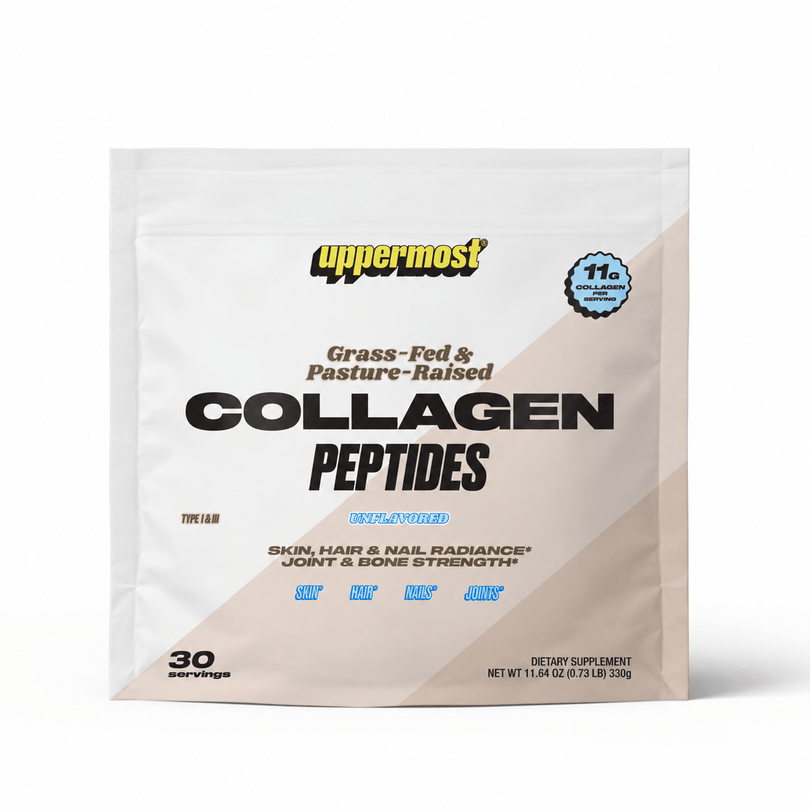
Hydrolyzed form matters. Standard collagen molecules are too large to absorb efficiently. Hydrolyzed collagen peptides are broken down into smaller chains that pass through the gut wall directly into the bloodstream — which is why hydrolyzed collagen, like Uppermost, is the only form worth taking.
Sourcing quality. Grass-fed, pasture-raised bovine collagen tends to have a cleaner amino acid profile compared to grain-fed sources. Uppermost sources exclusively from grass-fed, pasture-raised cattle in Argentina — cattle that graze freely on open pastures year-round, without unnecessary hormones or additives.
The Mistake That Wastes All Your Progress
There's one pattern that shows up repeatedly: people quit too early.
Most people who try collagen and conclude "it didn't work" stopped somewhere around weeks 2–4 — right before the first meaningful results typically emerge. The biology requires sustained, consistent signaling to produce structural change. One or two weeks of occasional use won't get you there — but 8–12 weeks of daily use will, for most people.
Give it the time it actually needs before drawing any conclusions.
Setting Yourself Up to Succeed
A few practical habits that support the timeline:
- Make it automatic. Add collagen to something you already do every morning — coffee, tea, a smoothie. Uppermost Collagen is completely unflavored and dissolves instantly, so it fits into any existing routine without changing a thing.
- Start the clock. Note the date you start, and give yourself a genuine 8-week minimum before evaluating results.
- Photograph your skin. Gradual changes are easy to miss day-to-day. A weekly photo in the same lighting is the most reliable way to track progress objectively.
- Pair with vitamin C. A simple habit that supports collagen synthesis without any extra effort.
The Bottom Line
Collagen is not a quick fix — and any brand that suggests otherwise isn't being honest with you. But it is a genuinely effective, well-researched supplement with a predictable, consistent timeline.
Expect subtle early changes around weeks 4–6. Expect real, visible differences by weeks 8–12. Expect the full picture to develop over 3–6 months of consistent daily use.
One scoop a day. Every day. Give it the time it needs — and it will deliver.
Ready to start the clock? Uppermost Grass-Fed Collagen Peptides — 11g per scoop, hydrolyzed Type I & III, sourced from grass-fed pasture-raised bovine in Argentina.