

If you've spent any time researching MCT oil, you've probably run into the alphabet soup of C8 and C10. Both are medium-chain triglycerides, both come from coconut oil, and both can support energy and ketosis — but they are not equal. The difference comes down to molecular structure, and that seemingly small detail has a big impact on how your body uses them.
This guide breaks down exactly what caprylic acid (C8) and capric acid (C10) are, how they differ in absorption speed, energy production, gut health, and cognitive function, and why choosing the right one can meaningfully affect your results.
What Are MCTs — and Why Does Chain Length Matter?
Medium-chain triglycerides are fatty acids with carbon chains between 6 and 12 atoms long. Unlike long-chain triglycerides found in most dietary fats, MCTs bypass the lymphatic system entirely. They travel directly from your gut to the liver via the portal vein, where they are rapidly converted into ketones: a clean, fast-burning fuel for your brain and muscles.
The four main MCTs are caproic acid (C6, rare and irritating to the gut), caprylic acid (C8, the fastest for ketone conversion), capric acid (C10, moderate speed with a broader antimicrobial profile), and lauric acid (C12, which behaves more like a long-chain fat and is frequently debated as a true MCT).
Among these, C8 and C10 are the most relevant for supplementation. Their one-carbon-chain difference has outsized effects on how quickly your body can put them to work. Think of it like a wood stove: C8 is kindling that catches fast and burns hot, while C10 is a slightly thicker log that takes longer to ignite but keeps the fire going a little longer.
Caprylic Acid (C8): The Fast-Twitch Fatty Acid
Caprylic acid — also called octanoic acid — is an eight-carbon saturated fatty acid found naturally in coconut oil, palm kernel oil, and trace amounts in dairy. It makes up roughly 6–9% of raw coconut oil, but is heavily concentrated in high-quality MCT supplements.
C8 is the shortest true MCT used in supplementation, and that brevity is its superpower. The fewer carbon bonds the liver needs to break, the faster it produces ketones.
Rapid ketone production. C8 is metabolised into ketones roughly three times faster than C10. Research suggests peak blood ketone levels can appear within 60–90 minutes of ingestion — making it the go-to choice for immediate cognitive or physical energy.
Gut microbiome support. C8 is one of the most well-studied natural antifungals. It disrupts the cell membranes of Candida albicans and other pathogenic organisms without meaningfully harming beneficial bacteria — an important distinction compared to pharmaceutical antifungals.
Brain fuel. Neurons cannot directly burn fatty acids, but they thrive on ketones. By flooding the bloodstream with beta-hydroxybutyrate (BHB), C8 provides a readily available, glucose-independent energy source that supports focus, memory consolidation, and sustained attention.
Appetite regulation. Ketone production from C8 suppresses ghrelin (the hunger hormone) and increases peptide YY, a satiety signal — making it particularly useful for intermittent fasting protocols and anyone trying to reduce snacking between meals.
Capric Acid (C10): The Steady-State MCT
Capric acid, or decanoic acid, has ten carbon atoms and makes up roughly 9–10% of coconut oil. It converts to ketones more slowly than C8, but that slower release has real utility in certain contexts.
Sustained energy. Where C8 delivers a quick spike in ketones, C10 produces a more gradual rise. This can smooth out energy levels over longer periods — useful for endurance training or extended work sessions where a sharp peak isn't necessary.
Antimicrobial activity. C10 also disrupts pathogenic cell membranes. Some research suggests it may have a broader spectrum of activity against gram-positive bacteria than C8, though its antifungal potency is generally considered weaker.
Cost efficiency. Because C10 is more abundant in raw coconut oil, it is cheaper to produce and is frequently blended with C8 in commercial MCT products to reduce manufacturing costs. If you see a C8/C10 blend on a label, the C10 is often there for economic, not physiological, reasons. It's worth knowing that before you pay a premium for a "blend."
C8 vs C10: Key Differences at a Glance
| C8 Caprylic Acid | C10 Capric Acid | |
|---|---|---|
| Carbon atoms | 8 | 10 |
| Ketone conversion | Fastest (~3x quicker) | Moderate |
| Antifungal potency | Very strong | Moderate |
| Brain fuel efficiency | High — rapid BHB supply | Moderate — slower release |
| Taste and texture | Light, neutral | Slightly heavier |
| Best for | Quick energy, keto, gut health | Sustained energy, blended products |
Why Pure C8 Outperforms Blends for Most People
The MCT supplement market is full of C8/C10 blends marketed as "full-spectrum" or "complete" MCT oil. Most of them exist to reduce cost, not optimise outcomes.
For energy and ketosis, C8's speed advantage is decisive. If your goal is fast, reliable ketone production — whether for keto diet support, pre-workout fuel, or breaking a fast without disrupting ketosis — you're not waiting for C10 to catch up.
For cognitive performance, the brain is highly sensitive to the rate of ketone delivery. C8's rapid conversion means faster access to BHB. Many users report clearer focus within 30–45 minutes, a timeline consistent with its pharmacokinetics.
For gut health, caprylic acid's antifungal activity against Candida is well-documented. A blend dilutes the therapeutic dose of the active component — if C8 is what works, you want more of it, not less.
For weight management, C8's ability to promote fat oxidation and support satiety gives it an edge over C10 in this area too. The combination of appetite suppression and metabolic efficiency makes it a meaningful tool alongside a healthy diet, not just a trendy supplement.
How to Use C8 MCT Oil Powder
MCT oil powder dissolves easily in hot and cold liquids and has a lighter taste profile than liquid MCT oil, making it far more versatile. It also tends to be easier on the stomach — a common complaint with liquid MCT formats, especially for first-time users.
Morning coffee or matcha. Add one to two scoops to your morning brew for clean energy without a glucose spike. This is the classic bulletproof approach, and for good reason — it works.
Pre-workout. Take 10–15 g of C8 powder 30–45 minutes before training for rapidly available fuel. Particularly effective for fasted training where you want energy without carbohydrates.
Extended focus sessions. Add a scoop to herbal tea or sparkling water during demanding work periods for a ketone boost without extra caffeine.
Breaking a fast. A small serving of C8 MCT powder can provide fuel without triggering a meaningful insulin response, keeping it compatible with most intermittent fasting protocols.
Starting out? Begin with 5 g per day and increase by 5 g every few days. Always take MCT oil with food or in a blended drink — never as a standalone shot on an empty stomach.
Why Uppermost Uses Pure C8
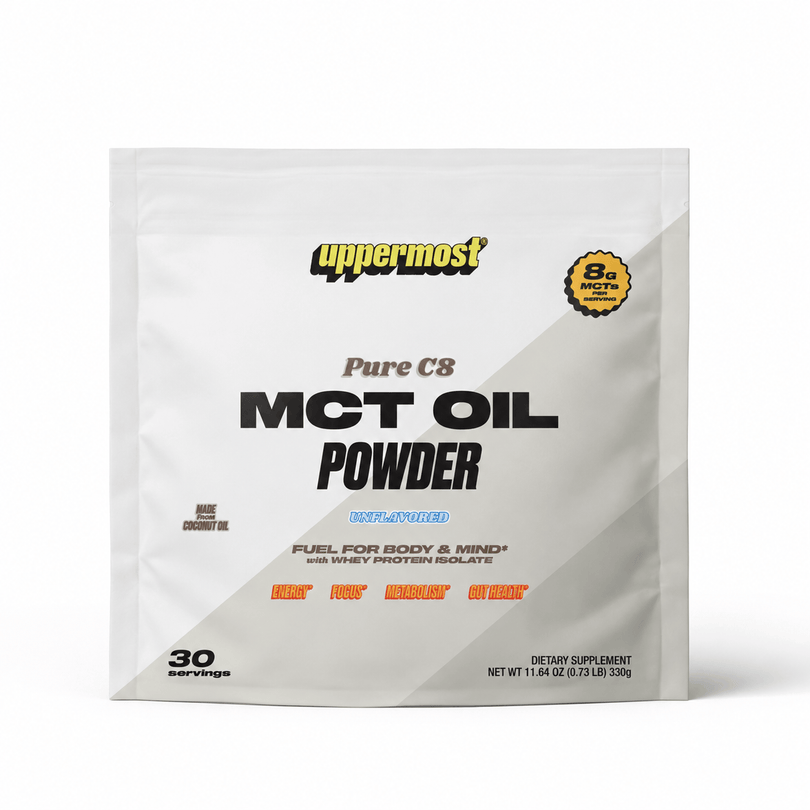
Uppermost MCT Oil Powder is made with 100% pure caprylic acid sourced from sustainably harvested coconuts. No C10 filler. No acacia fiber — we use whey protein isolate as a carrier instead, which provides a cleaner texture and an added source of amino acids.
The decision to use only C8 was deliberate. Most commercial MCT products blend in C10 because it is cheaper to produce. The result is a product that looks similar on the label but delivers less per gram. We built Uppermost around a simple principle: if a better ingredient exists, use it.
Every batch is third-party tested for purity, so what's on the label is what's in the bag — nothing more, nothing less.
The Bottom Line
Both C8 and C10 are legitimate MCTs with real benefits. But if you're supplementing with a specific goal in mind — faster energy, sharper focus, better gut health, or consistent ketosis support — C8 is the more targeted, better-studied, and faster-acting option.
The one-carbon difference between them is small on paper and significant in practice. C8 converts faster, reaches the brain sooner, and delivers more potent antifungal activity. For most people seeking MCT supplementation, pure C8 is the cleaner choice.
Ready to try it? Uppermost MCT Oil Powder — pure C8 from coconuts, no fillers, no compromise.