
MCT Oil vs. MCT Powder: What's the Difference and Which Should You Choose?
Quick answer: Both MCT oil and MCT powder deliver the same core benefits—fast ketone production, clean energy, and fat metabolism support. The difference comes down to form, digestibility, and how you use them. For most people, MCT powder wins on practicality—and if you're choosing a powder, the carrier ingredient matters more than most brands will tell you.
What Are MCTs?
Medium-chain triglycerides (MCTs) are a class of saturated fat with a unique metabolic shortcut. Unlike the long-chain fats found in most foods, MCTs bypass normal fat digestion. They don't require bile for breakdown and skip the lymphatic system entirely—instead traveling directly from your gut to the liver via the portal vein, where they're rapidly converted into ketones: a fast, clean fuel source for the brain and muscles.
There are four MCTs, ranked by how efficiently they convert to ketones:
| MCT | Name | Chain Length | Ketone Efficiency |
|---|---|---|---|
| C6 | Caproic acid | 6 carbons | High, but causes GI distress |
| C8 | Caprylic acid | 8 carbons | Highest — gold standard |
| C10 | Capric acid | 10 carbons | Moderate |
| C12 | Lauric acid | 12 carbons | Low — behaves like a long-chain fat |
This distinction matters when choosing a product. Most MCT supplements are blended—often dominated by C12 (lauric acid), which makes up the bulk of coconut oil but provides minimal ketogenic benefit. Pure C8 is what you want.
MCT Oil: What It Is and How It Works
MCT oil is created by fractionating coconut oil—isolating and concentrating the medium-chain fatty acids into a clear, odorless liquid. It's highly concentrated (typically 13–15g MCTs per tablespoon), absorbs rapidly, and converts to ketones within minutes of consumption.
What MCT oil does well:
- Provides the highest concentration of MCTs per serving
- Absorbs quickly for a fast energy response
- Works well drizzled on salads, added to soups, or blended into dressings
- No carrier ingredients—pure fat
Where MCT oil falls short:
- Notorious for causing digestive distress (bloating, cramping, loose stools) especially at higher doses or when first starting out
- Oily texture that separates in coffee and cold drinks—you need a blender
- Messy to travel with, heavy in a glass bottle, and prone to leaking
- Low smoke point (~320°F), making it unsuitable for high-heat cooking
MCT Powder: What It Is and How It Works
MCT powder starts as MCT oil. It's converted into dry powder form through a process called spray drying—the oil is homogenized with a carrier ingredient, atomized into tiny droplets, and dehydrated with hot air until a fine, stable powder is produced.
The carrier is what binds the oil to the powder matrix, and it's the most important quality factor in any MCT powder. Common carriers include:
- Acacia fiber — a natural prebiotic fiber, clean and gut-friendly
- Whey protein isolate — adds protein, creates a creamy texture, good for digestion
- Maltodextrin or tapioca starch — cheap fillers that spike blood sugar and can block ketone production (avoid these)
What MCT powder does well:
- Easier on digestion than liquid oil—the emulsified form is gentler on the gut
- Mixes into coffee, shakes, and smoothies without an oily film or blender
- Travel-friendly and mess-free
- Versatile: works in baking, cooking, and cold drinks
- A 2017 peer-reviewed study published in the Journal of Nutrition found that emulsified MCT (as in powdered form) produced a stronger ketogenic response and fewer digestive side effects compared to the same dose of non-emulsified MCT oil
Where MCT powder falls short:
- Slightly less concentrated than liquid oil—typically 8–12g MCTs per serving vs. 13–15g for oil
- Quality varies enormously—cheap powders with maltodextrin can counteract the entire point of taking MCTs
- Slightly higher cost per serving for clean, high-quality versions
Head-to-Head Comparison
| Factor | MCT Oil | MCT Powder |
|---|---|---|
| MCT concentration per serving | Higher (~13–15g) | Slightly lower (~8–12g) |
| Ketone production speed | Fast | Fast to slightly faster (emulsification effect) |
| Digestibility | Often causes GI distress | Gentler—better tolerated |
| Mixability in coffee | Separates; needs blender | Dissolves cleanly, creates creamy texture |
| Cold drink use | ❌ Oily film | ✅ Mixes well |
| Cooking versatility | ❌ Low smoke point | ✅ Heat stable |
| Travel & portability | ❌ Heavy, can spill | ✅ Lightweight, mess-free |
| Purity risk | Lower (just oil) | Higher—carrier quality varies |
The Carrier Question: Why It Matters More Than the Brand
This is the most overlooked factor when comparing MCT powders. The carrier ingredient doesn't just hold the powder together—it directly affects how the product interacts with your metabolism.
Maltodextrin and tapioca starch are the most common cheap carriers. They're highly processed carbohydrates with a glycemic index similar to pure glucose. If you're taking MCT powder to stay in ketosis, support fat metabolism, or avoid blood sugar spikes, a product with maltodextrin is working against you.
Whey protein isolate and acacia fiber are the clean alternatives. They don't spike blood sugar, support digestibility, and in the case of whey protein isolate, add a small protein benefit alongside the MCT dose.
Always read the label. A product that lists "MCT oil" and then "tapioca maltodextrin" isn't the clean supplement it's marketed as.
Which One Is Right for You?
Choose MCT oil if:
- You want the highest possible MCT concentration per serving
- You primarily add it to recipes, dressings, or cooked foods (at low heat)
- You've built up a tolerance and don't experience digestive issues
- You want the absolute simplest ingredient list
Choose MCT powder if:
- You add MCTs to coffee every morning and want it to blend smoothly
- You've ever experienced stomach discomfort from liquid MCT oil
- You travel regularly or need a portable option
- You use it in baking, smoothies, or cold drinks
- You're new to MCTs and want a gentler introduction
For most people reading this, powder is the more practical daily-use option—provided you choose one with a clean carrier.
A Note on Dosing
Whether you use oil or powder, start low. The most common mistake is taking a full serving on day one and spending the next few hours regretting it.
MCT oil: Start with 1 teaspoon and work up to 1 tablespoon over 1–2 weeks.
MCT powder: Start with ½ scoop and increase to 1–2 scoops based on tolerance and goals.
Both forms are safe for daily use for most healthy adults. If you have liver issues or other metabolic conditions, check with your doctor first.
Uppermost C8 MCT Oil Powder
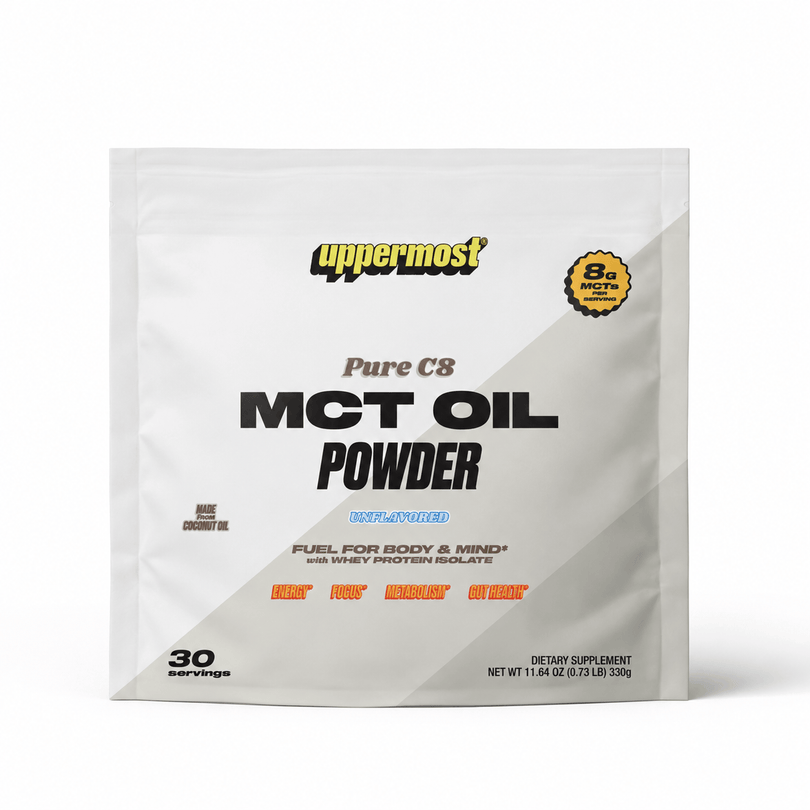
Most MCT powders are made with blended MCTs (C8 + C10 + C12) and cheap carriers. Uppermost's MCT Oil Powder uses 100% pure C8 caprylic acid sourced from coconuts with whey protein isolate as the carrier—no maltodextrin, no acacia fiber, no fillers.
The result is a powder that dissolves clean in hot or cold drinks, digests easily, and delivers the full ketogenic benefit of C8 without any of the shortcuts that make cheaper products less effective.
Shop Uppermost C8 MCT Oil Powder →
Frequently Asked Questions
Is MCT powder as effective as MCT oil? Yes—and potentially more so. A 2017 clinical study found that emulsified MCT (the form used in powder) was more ketogenic and caused fewer side effects than the same dose of non-emulsified liquid oil. The key variable is carrier quality: a powder with clean ingredients matches or exceeds oil; one with maltodextrin does not.
Does MCT powder break a fast? It contains calories (primarily fat), so it technically ends a true fast. However, it doesn't spike blood sugar or insulin, so it preserves most of the metabolic benefits associated with fasting. Many intermittent fasters use it in their morning coffee without concern.
Can you cook with MCT powder? Yes—MCT powder is heat stable and can be added to baking recipes, oatmeal, energy balls, and other cooked foods. Liquid MCT oil is not suitable for high-heat cooking due to its low smoke point.
Is MCT powder good for keto? MCT powder with a clean carrier (whey protein isolate or acacia fiber) is one of the best supplements for ketogenic dieters. Pure C8 powder supports ketone production, provides clean energy without carbs, and helps manage appetite. Avoid powders with maltodextrin—they can raise blood sugar and undercut the point of keto.
How much MCT powder should I take per day? Most people do well with 1–2 scoops per day. Start with ½ scoop to gauge tolerance and build from there.
MCT oil vs. coconut oil—what's the difference? Coconut oil contains MCTs, but only about 15% of it is C8 and C10—the highly ketogenic MCTs. The rest is C12 (lauric acid) and other long-chain fats. MCT oil and MCT powder are concentrated extracts, giving you a much more effective dose per serving.