
Walk into any supplement aisle — or scroll through any online store — and you'll find dozens of collagen peptide products all making roughly the same promises: better skin, stronger hair, healthier joints. The packaging looks similar. The claims sound similar. The prices vary wildly.
So how do you actually tell the difference between a quality collagen product and one that's riding a trend with inferior ingredients? The answer is almost always on the label — if you know what you're looking at.
Here's a straightforward guide to reading a collagen peptides label, what the good signals look like, and what should give you pause.
Start With the Ingredient List
The ingredient list is the single most telling part of any supplement label. For collagen peptides, a high-quality product should have a very short one.
What you want to see: Hydrolyzed collagen peptides (sometimes listed as "bovine hide collagen peptides" or "hydrolyzed bovine collagen") as the first and ideally only ingredient. That's it. A clean collagen product needs nothing else to do its job.
What to be cautious about: Long ingredient lists with fillers, artificial sweeteners, natural flavors, maltodextrin, or proprietary blends. These additions often signal that the base collagen quality is being compensated for, or that the product is optimized for taste and shelf appeal rather than efficacy. If you can't identify what an ingredient is or why it's there, that's worth questioning.
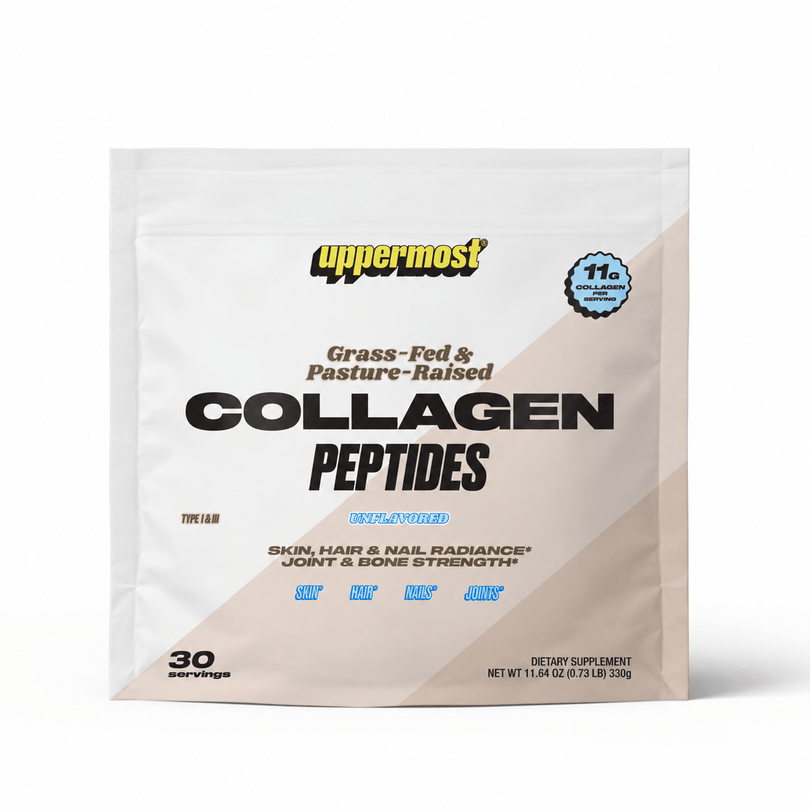
Uppermost Collagen Peptides contains one ingredient: hydrolyzed bovine collagen peptides. Nothing else is needed, so nothing else is added.
Check That It's Hydrolyzed
This one is non-negotiable. Standard collagen molecules are large proteins that your digestive system cannot efficiently absorb intact. Hydrolysis is the process that breaks collagen down into shorter peptide chains — small enough to pass through the gut wall and into the bloodstream, where they can do their work.
On a label, look for the words "hydrolyzed" or "collagen peptides" — these terms indicate the product has been properly processed for absorption. If a product simply says "collagen" or "collagen protein" without specifying hydrolyzed, it may not be in a form your body can readily use.
All the clinical research supporting collagen's benefits — for skin, joints, hair, and nails — is based on hydrolyzed collagen peptides. This is the only form worth taking.
Know Your Collagen Types
Not all collagen types do the same thing, and the label should tell you which type you're getting.
Type I and Type III are the most abundant collagen types in the human body. Type I is the primary structural protein in skin, hair, nails, tendons, and bones. Type III works alongside it, particularly in skin and blood vessel walls. Bovine collagen naturally contains both Type I and Type III — making it the most relevant choice for people focused on skin health, anti-aging, hair, nail, and joint support.
Type II collagen is found primarily in cartilage and is more specific to joint health. It's typically derived from chicken rather than bovine sources and is studied at very different doses.
For most people's goals — particularly skin, hair, nails, and general anti-aging — Type I and III bovine collagen is the right choice. Make sure the label specifies which type you're getting rather than leaving it vague.
Look for Sourcing Information
Where the collagen comes from matters — and a quality brand will tell you clearly.
Grass-fed and pasture-raised are the sourcing terms to look for on a bovine collagen product. Grass-fed means the cattle ate a natural grass diet rather than grain. Pasture-raised means they had genuine access to open pasture rather than being confined to a feedlot. Both terms together represent the highest sourcing standard.
Country of origin is another meaningful signal. Brands that name where their collagen comes from — rather than leaving it unnamed — are demonstrating a level of transparency that reflects confidence in their supply chain. Vague sourcing language is often a sign that the origin isn't something the brand wants to highlight.
Uppermost sources exclusively from grass-fed, pasture-raised bovine cattle in Argentina, where cattle graze on open pastures year-round. That specificity is intentional — it's a sourcing standard the brand is proud to name.
Check the Serving Size and Collagen Content
The label should clearly state how much collagen you're getting per serving. This matters because dosage is directly tied to results — and some products use serving sizes that look impressive on the front of the package but deliver far less collagen than the research-supported range.
Most clinical studies on collagen's benefits use doses in the 10–15g range per day. Check the nutrition facts panel for the actual grams of collagen per serving — not the total serving weight, which may include other ingredients.
A product that delivers 10g or more of pure collagen peptides per serving, with no fillers diluting that amount, is what you're looking for. Uppermost delivers 11g of collagen per scoop — a single, straightforward serving that sits right in the clinically studied range.
Look for Third-Party Certifications
Supplement manufacturing is not as tightly regulated as food or pharmaceuticals, which means the burden of quality verification often falls on the brand itself — or on independent third parties.
Certifications to look for:
- Non-GMO verified: confirms the product meets non-GMO standards through third-party verification
- Gluten-free certified: important for anyone with gluten sensitivity or celiac disease
- Informed Sport or NSF Certified for Sport: relevant for athletes who need to ensure no banned substances are present
These certifications add a layer of accountability that goes beyond the brand's own claims. A product that carries them has been independently verified — which means you don't have to take the brand's word for it.
Watch Out for These Red Flags
A few specific things on a collagen label that should give you pause:
"Proprietary blend" — This language is used to avoid disclosing exact ingredient amounts. In a product that should have one ingredient, a proprietary blend label is a significant red flag.
Artificial sweeteners or flavors — If you're buying an unflavored collagen, there's no reason for these to be present. Their presence suggests the base product needs masking.
Vague sourcing language — "Bovine collagen" with no mention of grass-fed, pasture-raised, or country of origin often means the collagen comes from conventional feedlot cattle. The brand simply isn't saying so explicitly.
Underdosed servings — A product with a 5g serving size dressed up in attractive packaging may be delivering half the collagen you actually need per day.
No expiration date or lot number — These are basic quality control markers. Their absence suggests manufacturing standards worth questioning.
The Simple Version
If you want a quick mental checklist when evaluating any collagen product:
- Is it hydrolyzed? ✓
- Does it specify Type I and III? ✓
- Is the ingredient list short and clean? ✓
- Does it say grass-fed and pasture-raised? ✓
- Does it name the country of origin? ✓
- Does it deliver 10g+ of collagen per serving? ✓
- Does it carry third-party certifications? ✓
If a product checks all of these boxes, you're looking at something worth buying. If it can't answer several of them, keep looking.
Uppermost Grass-Fed Collagen Peptides checks every box. One ingredient, 11g per scoop, grass-fed and pasture-raised in Argentina, non-GMO, gluten-free, nothing artificial. See for yourself.